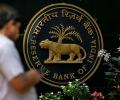
The government on Tuesday appointed three external members -- Ram Singh, Saugata Bhattacharya and Nagesh Kumar -- to the RBI's rate-setting Monetary Policy Committee for four years. The central government has reconstituted the Monetary Policy Committee (MPC) of RBI, the finance ministry said in a statement. Ram Singh is the director of the Delhi School of Economics, Saugata Bhattacharya is an economist, and Nagesh Kumar is the director and Chief Executive, Institute for Studies in Industrial Development, New Delhi.
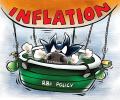
The Reserve Bank of India (RBI) has projected retail inflation at 4.2 percent for the next financial year beginning April while retaining the forecast for 2024-25 at 4.8 percent. The central bank attributed the expected easing of inflation to good kharif production, winter-easing in vegetable prices and favorable rabi crop prospects. However, the RBI also noted that continued uncertainty in global financial markets coupled with volatility in energy prices and adverse weather events presents upside risks to the inflation trajectory.

'Credit growth in India remains in double digits, even though corporate borrowing is subdued.' 'Corporate credit is weak because companies are cash-rich and cautious amid global uncertainty.'

Uncertainties over the impact of the United States' (US') tariffs on India, along with the ongoing transmission of past rate cuts, prompted the members of the Reserve Bank of India's Monetary Policy Committee (MPC) to maintain the status quo during the August meeting, the minutes showed. While some of the external members highlighted their concern over growth, the internal members cited the one-year headline inflation rate overshooting the 4 per cent target.

'The government's decision to keep interest rates unchanged on small savings schemes will certainly constrain banks' ability to cut deposit rates further.'
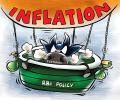
The Reserve Bank on Wednesday lowered the inflation projection for the current fiscal to 4 per cent from 4.2 per cent earlier, taking into account good agricultural output and falling crude prices.

Despite a strong 7.8 per cent growth in the first quarter, the Indian economy is expected to grow at 6.5 per cent in the current financial year as the impact of US tariffs on Indian exports will reduce prospects, particularly in the second half, ADB said on Tuesday.

The change in stance to neutral from accommodative in the June monetary policy meeting does not necessarily signal that the Reserve Bank of India's (RBI's) rate setting body - monetary policy committee (MPC) - will go on a prolonged pause on rate cuts going forward, believe experts.

The Reserve Bank of India (RBI) is expected to cut interest rates for the first time in nearly five years in Governor Sanjay Malhotra's first monetary policy committee (MPC) meeting on Wednesday. The meeting of the six-member MPC, which will culminate on Friday, aims to boost sluggish economic growth, which is seen falling to a four-year low. Malhotra took charge as the 26th RBI governor in December last year.
'Deposit and lending rates have started to fall considerably. It is likely to spur investment and consumption of durables.'
While participants in the domestic financial market are expecting a 25 basis-point policy repo rate cut in the December meeting of the Monetary Policy Committee (MPC) of the Reserve Bank of India (RBI), economists remain torn between a reduction in rate cut and a pause.
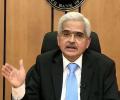
The Reserve Bank of India on Wednesday decided to keep the policy rate unchanged for the tenth time in a row but changed its stance to 'neutral' that may lead to a cut in the forthcoming policies. RBI maintained status quo despite the US Federal Reserve lowering the benchmark rates by 50 basis points last month.

'Once bitten, twice shy, I didn't take up the challenge this time...' 'I realised I had failed to follow my karma because I feared failure.'
'I will not be surprised if there is a 7 per cent handle in front of the decimal place for the full financial year.'

Reserve Bank on Wednesday cut India's growth forecast to 6.5 per cent from 6.7 per cent estimated earlier for the current financial year on account of impact of global trade and policy uncertainties. Prospects of agriculture sector remain bright on the back of healthy reservoir levels and robust crop production in 2025-26, RBI Governor Sanjay Malhotra said while unveiling the outcome of the first bi-monthly Monetary Policy Committee meeting for the current financial year.

State-owned Bank of Baroda (BoB) on Sunday said it has cut its benchmark lending rate linked to repo rate by 50 basis points in line with the RBI's rate reduction. Meanwhile, private sector HDFC Bank reduced its Marginal Cost of Funds-based Lending Rates (MCLR) by 10 basis points across tenure, which will benefit borrowers whose loans are linked to this benchmark.
Reserve Bank of India (RBI) Governor Sanjay Malhotra said the repo rate cut in the February meeting of the monetary policy committee (MPC) was due to inflation aligning with the target and recognising the fact that monetary policy is forward-looking.
The RBI is likely to reduce the key interest rate by 25 basis points this week after keeping it on hold for two years, complementing the Union Budget initiatives to push consumption-led demand, though the sliding rupee continues to be a concern. As the retail inflation has remained within the Reserve Bank's comfort zone (less than 6 per cent) for most of the year, the central bank can take rate action to boost growth hit by sluggish consumption, opined experts.
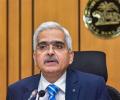
The Reserve Bank of India on Thursday decided to keep policy rate unchanged for the sixth time in a row as it maintains a tight vigil on inflation. The rate increase cycle was paused in April last year after six consecutive rate hikes aggregating to 250 basis points since May 2022.
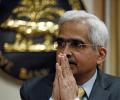
Uncertainty is emerging as the only certainty, said RBI Governor Shaktikanta Das as he emphasised on continued policy support at the December MPC meet during which members expressed concerns over spread of the Omicron variant of coronavirus, as per the minutes of the rate-setting panel released on Wednesday. After three days of deliberations, the six members of the Monetary Policy Committee (MPC) on December 8 unanimously voted for status quo on policy rates for the ninth consecutive time. At the meeting, the RBI Governor said risks stalking the global economy have amplified with rapid spread of the virus mutations, including the Omicron variant, leading to countries scrambling for restrictions.
Amid a debate on the basis of a monetary policy stance, one may be curious enough to know how non-food retail inflation has behaved over the years in India. Let the eager souls catch a glimpse of facts. In the past 10 years, non-food inflation came down below 4 per cent on two occasions - pre-Covid period of 2019-20 and now in the first four months of the current financial year (FY25).

India is growing fast, but to keep growing strong, the government must make more things at home, create jobs, and spend money wisely, suggests Rajiv Memani, regional managing partner, Africa-India Region, EY.
The RBI on Wednesday slashed key interest rate by 25 basis points, for the second time in a row, to support a shuttering economy hit by reciprocal tariffs imposed by the US. Following the rate cut, the key policy rate eased to 6 per cent providing relief to home, auto and corporate loan borrowers.
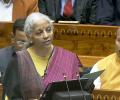
Budget 2026 sticks to fiscal discipline, shuns populist measures despite five key state elections coming up, but ends up rattling stock markets with a higher transaction tax on derivatives trading.

State Bank of India, Adani Ports, Tata Consultancy Services, ICICI Bank, Reliance Industries and PowerGrid were also among the laggards.
The repo rate cut by 25 basis points by the monetary policy committee (MPC) of RBI announced Friday will give a long-awaited relief on interest rates and also be supportive of economic growth, according to experts. Repo rate is the interest rate at which the RBI lends money to commercial banks.

A day after his appointment as the 26th governor of the Reserve Bank of India (RBI), outgoing Revenue Secretary Sanjay Malhotra on Tuesday said one must understand the economic landscape and do what was best for the economy. "Let me first go, join, understand the turf ... Here it is a different role," Malhotra said, speaking to reporters in front of North Block.

The Reserve Bank of India's (RBI) Monetary Policy Committee's (MPC) decision to cut the repo rate by 50 basis points (bps) to 5.5% was contrary to the expectations of many economists. Firstly, most of the economists expected the MPC to cut the repo rate by 25 bps citing the weakening of inflation, prospects of economic growth, geopolitical uncertainty and comfortable system liquidity.
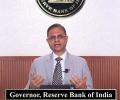
'India has the potential to grow at more than 7%, with the monetary policy providing a supportive hand.'
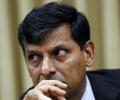
Govt likely to get full control on policy rate.

'If it doesn't, it will continue with measures to infuse liquidity, signalling a new cycle,' predicts Tamal Bandyopadhyay.

Deputy Governor Michael Patra warned about the spillover effects of food inflation.
The Reserve Bank of India on Friday raised the retail inflation target for the current financial year to 5.7 per cent on the back of rising global prices amidst the ongoing geo-political tensions, even as it expected the prices of cereals and pulses to soften on prospects of good winter crop harvest. "Global food prices along with metal prices have hardened significantly. "Economy is grappling with a sharp rise in inflation... Inflation is now projected at 5.7 per cent in 2022-23 with Q1 at 6.3 per cent; Q2 at 5 per cent; Q3 at 5.4 per cent and Q4 at 5.1 per cent," RBI Governor Shaktikanta Das said while unveiling the first monetary policy review for the current fiscal year.

India's consumer price index (CPI)-based retail inflation rate is likely to have cooled further in June, thus remaining below the 4 per cent target of the Reserve Bank of India (RBI) for a fifth consecutive month, giving the central bank wiggle room to focus on growth. Economists reckon that the decline is on account of easing prices in various categories of goods, especially food items, and a favourable base effect.
The government has invited applications for the post of deputy governor of the Reserve Bank of India (RBI) from interested candidates with at least 25 years of experience and below 60 years of age as on January 15, 2025. One of the deputy governors, Michael Patra's current term will end on 15 January. The last date of submission of applications is November 30, 2024.

Benchmark equity indices Sensex and Nifty pared early gains to settle lower on Wednesday due to late selling in index major Reliance Industries, ITC and HDFC Bank even as the RBI took the first step towards a rate cut in its monetary policy review. Erasing its early gains, the 30-share BSE Sensex fell 167.71 points or 0.21 per cent to close at 81,467.1. During the day, it surged 684.4 points or 0.83 per cent to hit an intra-day high of 82,319.21.
Since Sanjay Malhotra took office as governor in December, the Reserve Bank of India (RBI) has adopted a more accommodative stance, which bodes well for banking and the economy as they navigate a growth slowdown, according to analysts.

Perhaps because the Modi government had some differences of opinion with two of the economist governors (one of whom was appointed by the Manmohan Singh government), there is a view that its political leadership prefers a civil servant to head the RBI, notes A K Bhattacharya.

Facing criticism from the government over the central bank prioritising inflation over growth, the new RBI Governor Sanjay Malhotra on Monday said that prospects of the Indian economy are expected to improve on the back of high consumer and business confidence in 2025. "As we strive to preserve financial stability to support a higher growth path for the Indian economy, our focus remains steadfast on maintaining stability of financial institutions and, more broadly, systemic stability," Malhotra said in foreword to the Financial Stability Report.
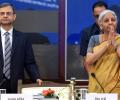
Sanjay Malhotra takes charge as the 26th RBI governor at a time when headline retail inflation has shot up to 6.2%.
 © 2026 Rediff.com - Advertise with us - Disclaimer - Privacy Policy - Sitemap - Feedback - About us - Terms of use - Grievances